The Future of Digital Fashion: From 3D Design to a New Digital Atelier
۳ شهریور ۱۴۰۵ · TWINZ STUDIO
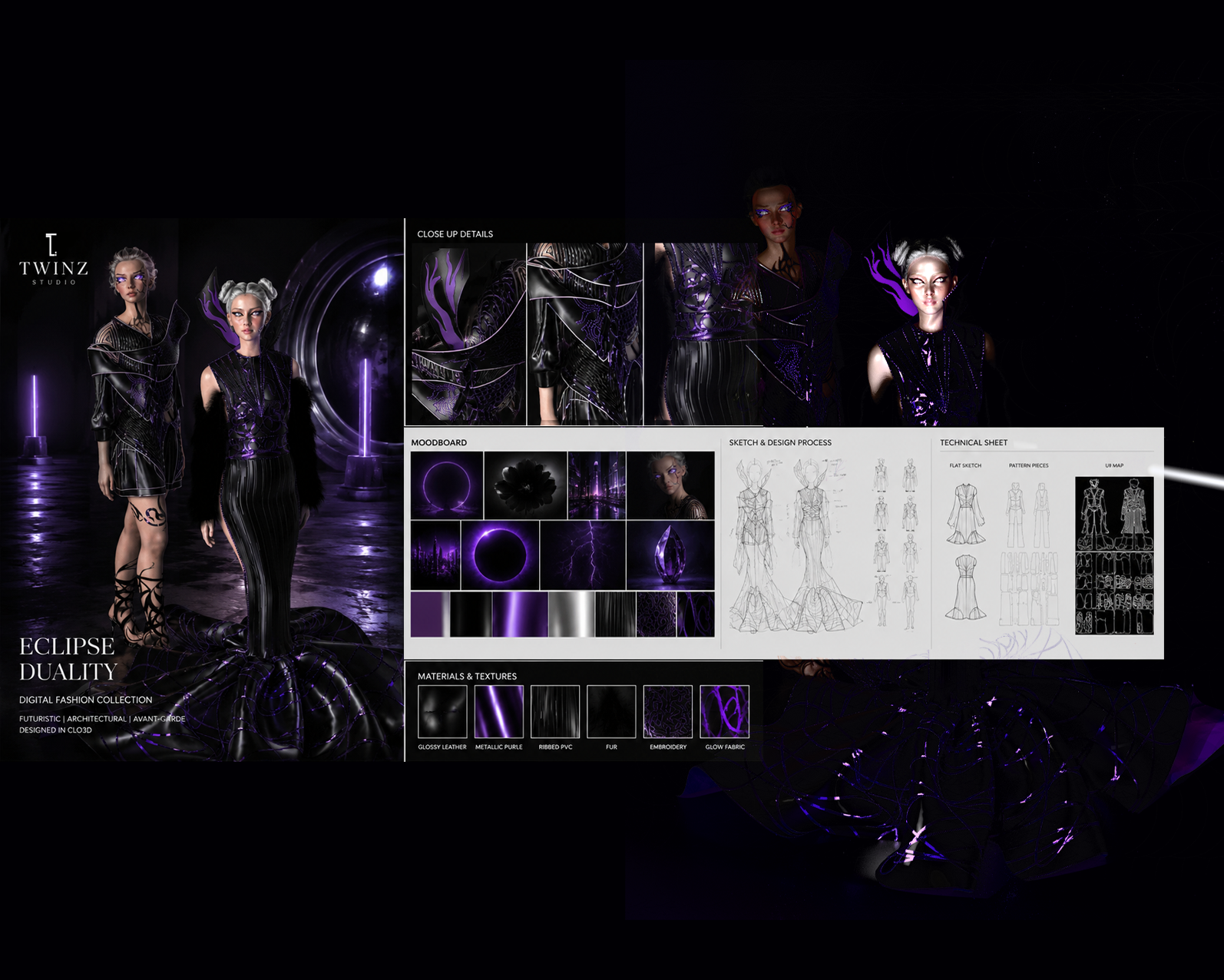
Digital fashion is moving beyond virtual garments and experimental technology. From 3D design and digital prototyping to AI-assisted workflows and virtual presentation, a new creative language is emerging—one where fashion can be imagined, developed, and experienced beyond the limits of the physical atelier.
Fashion has always evolved alongside technology. From industrial machinery and new textile processes to digital patternmaking and computer-aided design, every technological shift has changed the way designers imagine, develop, and produce garments.
Today, fashion is entering another significant transformation: the rise of digital fashion.
What began as a specialized tool for visualization and experimentation is becoming a broader creative environment. Designers can now develop garments in three dimensions, test proportions before physical sampling, explore material behavior digitally, create virtual presentations, and communicate ideas across physical and digital spaces.
Digital fashion is not simply about clothing that exists on a screen. It is about expanding the design process itself.
A New Way to Design
For generations, fashion design has been closely connected to the physical atelier. Designers sketch, drape, cut, sew, fit, adjust, and repeat. The physical process remains essential, but digital tools are introducing a new layer of possibility.
With 3D garment design, a concept can move from a two-dimensional sketch into a three-dimensional environment where silhouette, proportion, construction, volume, and material behavior can be explored before a physical garment is produced.
This changes the relationship between idea and execution.
A designer can test a sleeve shape, adjust the volume of a skirt, refine the position of a seam, experiment with fabric weight, or explore an entirely different silhouette without immediately producing another physical sample.
The digital environment therefore becomes more than a presentation tool. It becomes a space for thinking.
From Sketch to 3D Garment
The traditional fashion development process often begins with research and concept development, followed by sketching, patternmaking, sampling, fitting, and physical construction.
Digital fashion does not necessarily replace this process. Instead, it creates another pathway through which the same design decisions can be explored.
A fashion illustration can become a three-dimensional garment. A moodboard can become a digital collection. A pattern can be tested through simulation. A material reference can become a virtual textile. A construction idea can be examined from multiple viewpoints.
Tools such as CLO3D and Marvelous Designer have made this type of workflow increasingly accessible to fashion designers.
The value is not simply in producing a realistic render. The real value lies in being able to see and evaluate the garment while it is still being developed.
Iteration as Part of the Creative Process
Fashion design is rarely a straight line.
A first idea changes. A proportion feels wrong. A silhouette becomes stronger after several variations. A material behaves differently than expected. A construction detail creates a new design opportunity.
Iteration is therefore not a failure of the original idea. It is part of design itself.
Digital tools make this iterative process faster and more visible. Designers can create variations, compare alternatives, and return to earlier decisions without losing the overall development path.
This creates a more flexible relationship between experimentation and technical development.
Why 3D Fashion Matters
One of the most important advantages of 3D fashion is the ability to evaluate a garment before it becomes physical.
Silhouette can be studied from multiple angles. Proportions can be refined. Fabric behavior can be observed. Construction details can be tested. Styling can be explored.
For fashion designers, this creates a bridge between creative direction and technical development.
Instead of separating the creative and technical stages completely, digital workflows allow them to interact throughout the development process.
This can also reduce unnecessary physical sampling. While physical prototypes will remain important for many types of fashion development, digital prototypes can help designers identify problems and make decisions earlier.
The result is a workflow in which more creative possibilities can be explored before committing resources to physical production.
Digital fashion is not about replacing the physical garment. It is about expanding the possibilities of how a garment can be imagined, developed, communicated, and experienced.
Beyond Visualization
The possibilities of digital fashion extend beyond 3D rendering.
Digital garments can become part of virtual fashion presentations, digital campaigns, games, immersive experiences, social platforms, and emerging forms of online identity.
This creates a new question for designers:
What can a garment become when it is no longer limited to the physical body?
In the physical world, garments are influenced by gravity, material availability, manufacturing constraints, body movement, and production cost.
Digital environments introduce a different set of possibilities.
Designers can explore exaggerated proportions, unusual structures, unconventional surfaces, and visual effects that may be difficult or impossible to reproduce physically.
This does not make digital fashion superior to physical fashion. They simply offer different creative territories.
The Relationship Between Physical and Digital Fashion
The future of fashion is unlikely to be divided into two completely separate worlds.
Instead, physical and digital fashion will increasingly influence one another.
A digital prototype can inform a physical garment. A physical garment can become the basis for a digital experience. A traditional pattern can be developed in a 3D environment. A digital campaign can introduce a physical collection to an audience before it reaches the market.
This relationship creates a hybrid design ecosystem.
For designers, it means that digital literacy is becoming another layer of professional capability alongside illustration, patternmaking, textile knowledge, garment construction, and creative direction.
AI and the New Creative Workflow
Another major development shaping the future of fashion is artificial intelligence.
AI-assisted tools are increasingly being used for research, visual exploration, concept development, image generation, styling exploration, and communication.
However, the most valuable role of AI in fashion is not simply generating an attractive image.
Fashion design still requires intention.
A designer must understand why a silhouette works, how proportions affect the body, how materials behave, how a garment is constructed, and how an idea connects to a broader visual language.
AI can accelerate certain parts of the creative workflow, but design judgment remains essential.
The future may therefore belong less to the idea of AI replacing designers and more to designers learning how to direct, evaluate, refine, and integrate new technologies into their existing creative practice.
The Digital Atelier
We see the digital atelier as a space where fashion design, technology, research, and experimentation meet.
It is not a replacement for the traditional atelier. It is an extension of it.
Within a digital atelier, a designer can research references, build a concept, develop a silhouette, construct a garment, test materials, create variations, and communicate the final direction through high-quality digital presentation.
At TWINZ STUDIO, this approach connects fashion design with digital garment development, 3D visualization, creative research, and emerging technologies.
Our interest is not simply in making fashion digital.
It is in exploring what becomes possible when the boundaries of the traditional design process are expanded.
Designing for a More Flexible Future
As digital workflows become more integrated into fashion, designers may have greater freedom to experiment before making physical commitments.
Collections can be developed virtually. Design directions can be communicated remotely. Digital samples can support early decision-making. Visual stories can be created before production begins.
This flexibility can be particularly valuable in an industry where time, materials, sampling, and production resources all have an impact on the final result.
But technology alone does not create better fashion.
The quality of the outcome still depends on research, observation, design thinking, technical understanding, and the ability to make meaningful creative decisions.
What the Future of Fashion Might Look Like
The future of fashion will probably not be entirely physical, and it will not be entirely digital.
Instead, designers will move between both environments depending on the purpose of a project.
A collection might begin as physical research, develop through digital prototyping, return to physical sampling, and eventually exist in both physical and virtual forms.
A garment might be designed for the body, photographed for an editorial, recreated digitally for a virtual campaign, and later become part of an immersive experience.
The boundaries between these stages are becoming increasingly fluid.
What This Means for Fashion Designers
For emerging designers, this transformation creates both a challenge and an opportunity.
Traditional fashion knowledge remains important, but designers are also increasingly expected to understand digital tools, 3D workflows, visual communication, and new forms of creative technology.
The strongest future-facing designers may not be those who abandon traditional fashion skills, but those who can combine them with digital capabilities.
Understanding construction can improve digital garment development. Understanding textiles can improve virtual material selection. Understanding illustration can improve 3D concept development. Understanding visual communication can transform a technical process into a compelling fashion story.
Digital fashion therefore works best when technology and fashion knowledge are developed together.
The TWINZ Perspective
At TWINZ STUDIO, we are interested in the space between fashion and technology.
Our practice brings together fashion design, digital garment development, 3D visualization, creative research, and visual storytelling.
We believe that a digital garment is not simply a substitute for a physical sample. It can be a design object, a development tool, a communication medium, and a starting point for new creative possibilities.
Our digital atelier is built around that idea: creating a space where concepts can be explored freely, developed carefully, and presented with intention.
The Future Is Still Being Designed
Digital fashion is still evolving, and its final form has not yet been defined.
That uncertainty is part of what makes this moment so interesting.
New software, new creative tools, new forms of presentation, and new ways of experiencing clothing are continuing to emerge.
For designers, this means the future is not something that simply arrives. It is something that can be explored and shaped through design.
The digital atelier is becoming one of those spaces of exploration.
It is where an idea can move from research to sketch, from sketch to pattern, from pattern to 3D garment, and from garment to a new kind of fashion experience.
At TWINZ STUDIO, we are interested in exploring that space.
Where fashion meets technology. Where imagination becomes development. Where the digital atelier begins.